As institutions, campuses, resorts and commercial establishments across India increasingly adopt sustainable transport solutions, choosing the right electric bus becomes crucial. With rising demand for nimble, reliable and eco-friendly internal transport, many decision-makers seek clarity: Which bus model suits our needs best — a compact shuttle or a bigger 23-seater?
Based in Coimbatore, Tamil Nadu, Roots EV supplies a full range of electric mobility — from golf-carts and electric buggies to mini buses and full-fledged electric buses — with PAN India delivery and support. In this post, we present a complete comparison of Roots EV’s modern electric bus models: their specifications, ideal use-cases, pros and trade-offs. This will help you choose the most suitable model for your campus, resort, industrial park or gated community.
Why model comparison matters when selecting an electric bus
Before diving into model specs, it’s worth asking: Why is it important to compare different electric bus variants?
- Different seating capacity suits different user loads (small staff shuttle vs. full campus transport).
- Size, weight, and maneuverability affect usability in narrow lanes or tight campus roads.
- Battery, motor, and build specifications influence range, efficiency, and maintenance cost.
- Matching the bus type with actual needs ensures optimal total cost of ownership (TCO) and avoids under-utilization or overspending.
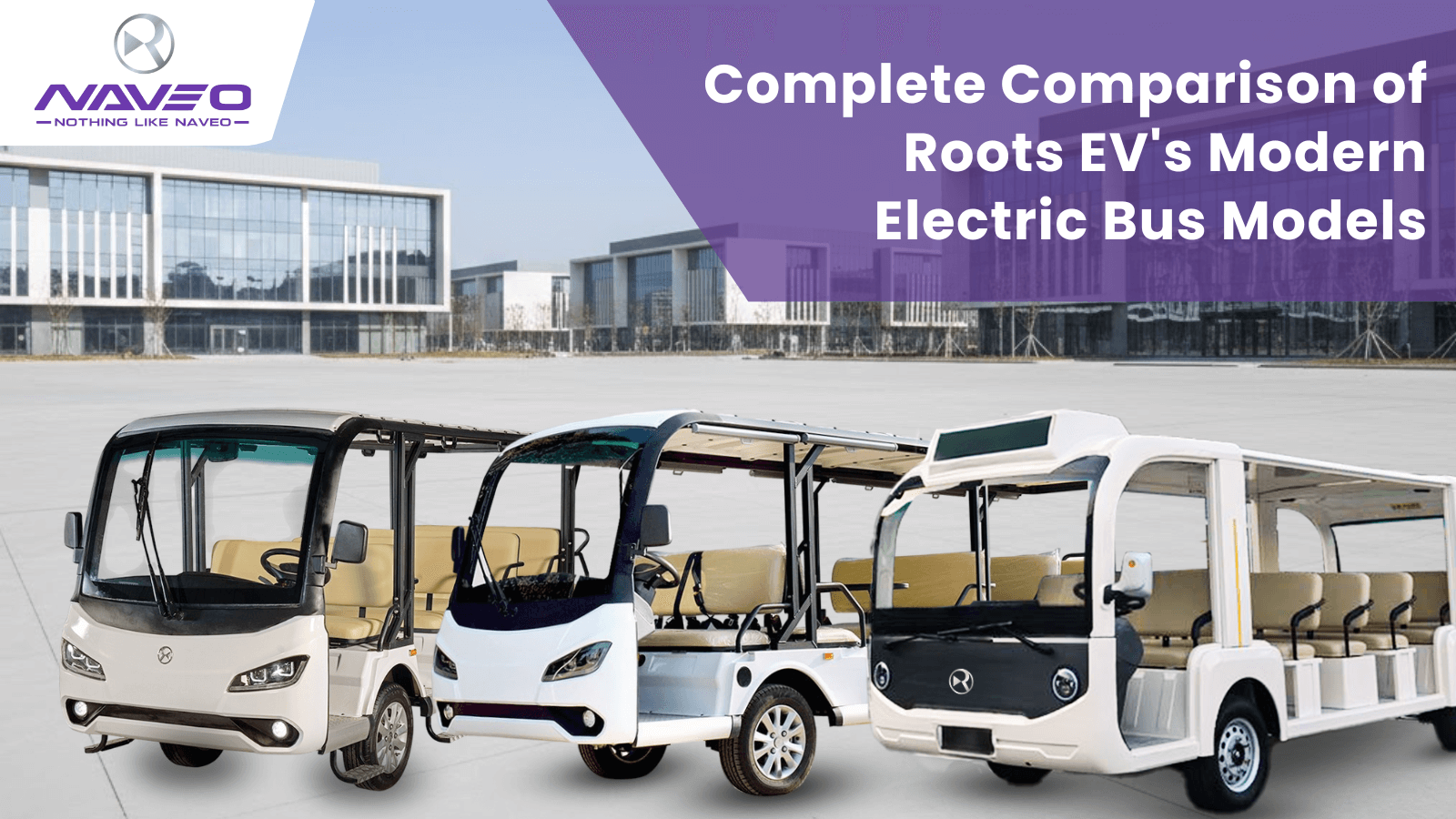
With that context, let’s compare Roots EV’s 14-, 18- and 23-seater electric buses.

What are the key Roots EV electric bus models and their specifications?
14-Seater Mini Electric Bus
Although not detailed in the public spec sheet like 18 and 23 seater, the 14-seater mini electric bus from Roots EV caters to compact-group transport:
- Best suited for resort-style shuttles, small campuses, guest transport, or low-density residential townships.
- Offers ease of parking and excellent maneuverability in tight roads or internal lanes.
- Lower purchase cost compared to larger buses, making it budget-friendly for smaller institutions.
- A great entry-level electric bus, especially for those transitioning from petrol or diesel golf carts or vans.
This 14-seater bus aligns with the broader category of mini electric bus or small electric shuttle, often considered in India’s electric mobility market for short-distance, low-capacity transport needs. (Roots Naveo)
18-Seater Electric Bus (RT-B-A18)
This mid-capacity model from Roots EV offers a balanced solution between compactness and passenger capacity. Its core specs include:
- Seating Capacity: 18 passengers
- Operating System: : 72V / AC system with a 10 kW motor, regenerative braking, and Curtis controller for a smooth drive.
- Charger: Onboard or offboard charger supporting 110–240 V input with 72 V, 30 A output.
- Speed: Up to 35 km/h — suitable for campus roads and internal routes.
- Range: Approximately 40–50 km on a lead-acid battery and 60–70 km if upgraded to lithium battery (on level roads at 20 km/h) — ideal for daily shuttle loops.
- Load & Climb Capacity: U: Up to 1500 kg loading, good hill-climb capability (30 % gradient when loaded).
- Compact Dimensions: Length ~5980 mm — easier to maneuver inside campuses, gated communities, resorts.
Use-case scenarios for 18-seater: medium-sized campuses, employee shuttles for corporate parks, hospital staff movement, residential township transit where 14-seater may be too small and 23-seater may be excessive.(Roots Naveo)
23-Seater Electric Bus (RT-B-A23)
For larger groups or frequent shuttle cycles, the 23-seater bus offers more capacity while still retaining maneuverability suited for internal routes. Key specifications: (Roots Naveo)
- Seating Capacity: 23 passengers
- Operating System: 96V / AC with a 20 kW permanent-magnet synchronous motor, regenerative braking and a reliable controller system.
- Charger: Onboard/offboard charger compatible with 110-240 V supply, output 96 V.
- Dimensions: 6120 × 1980 × 2330 mm — combines reasonable footprint with higher capacity.
- Performance: Designed to carry larger loads, suitable for routes with more passenger demand. Climbing capacity and payload capacity handled better than smaller buses.
- Ideal for campuses, resorts, factories, industrial parks and townships needing regular shuttle service for many people. (Roots Naveo)
Use-case scenarios for 23-seater: large universities and college campuses, big residential townships, industrial or corporate parks, airport transfers, resorts with high guest traffic, employee shuttles in factories.
How do these models compare — a quick side-by-side view
| Model | Seating Capacity | Ideal For | Maneuverability / Footprint | Use-Case Examples |
|---|---|---|---|---|
| 14-Seater Mini Electric Bus | ~14 (mini-bus class) | Small campuses, resorts, gated communities | High — easy parking & tight road navigation | Guest shuttle, staff transport, resorts |
| 18-Seater Electric Bus (RT-B-A18) | 18 | Medium campuses/resorts, moderate traffic | Compact but with more capacity than mini bus | Staff shuttle, small-to-mid size campus transport, hospital staff transit |
| 23-Seater Electric Bus (RT-B-A23) | 23 | Large campuses, factories, townships, high-demand routes | Moderate footprint — balanced size & capacity | University transport, township shuttle, factory shift transport, resort guest transfer |
This flexibility and range from 14-seater to 23-seater models illustrate why many institutions choose a mix — smaller ones for light demand, larger ones for peak hours or heavy usage.
What makes Roots EV a reliable electric bus manufacturer for your fleet in India?
- Pan India coverage & supply chain: Based in Coimbatore, Tamil Nadu, Roots EV supports delivery and after-sales across India — important for campuses or industries located outside metros.
- Range of vehicle sizes: Whether you need a compact shuttle bus or a heavier-duty 23-seater, Roots EV’s portfolio covers it all, enabling scaling as your campus or facility grows.
- Quality & customisation: From electric golf buggy and EV cart supplier experience to full-sized electric buses, Roots EV applies attention to chassis design, battery systems, motor efficiency and user comfort.
- Sustainability & total cost advantage: The modern electric bus models use efficient battery and drive systems, reducing operational costs vs. diesel/petrol and offering quiet, zero-emission transport — aligning with environmental goals. (Roots Naveo)
Which model should you choose — and when?
- If your campus or community has low to moderate transport demand, tight roads or requires guest-shuttles/resort transport → go for 14-seater mini electric bus.
- For medium passenger load, moderate campus size or staff-transport in corporate/hospital/residential settings → 18-seater electric bus (RT-B-A18) is the sweet spot.
- For large passenger volume, frequent shuttle cycles, university campuses, factories or township transport → 23-seater electric bus (RT-B-A23) offers the best balance of capacity and manageability.
Many institutions find value in a mixed fleet — small buses for daily small-group use and larger ones for peak-hour or bulk transit, ensuring cost-efficiency and flexibility.
Conclusion
Choosing the right electric bus model can transform internal mobility for your institution, campus, resort or industrial facility. With Roots EV’s range of 14-, 18- and 23-seater electric buses, you get flexibility, reliability and sustainability — all backed by a trusted manufacturer based in Coimbatore and serving PAN India.
Whether you’re just starting with EV adoption or scaling an existing fleet, contact Roots EV today for a consultation. Let us help you pick the ideal electric bus model — tailored to your passenger load, route demands and infrastructure — and deliver reliable, eco-friendly mobility for your campus or business.
Ready to upgrade to sustainable, efficient transport? Get in touch with Roots EV now.
Frequently Asked Questions (FAQs)
1. What seating capacities does Roots EV offer in its electric bus lineup?
Roots EV offers electric buses with 14-seater mini buses, an 18-seater electric bus, and a 23-seater electric bus, catering to different campus and facility requirements.
2. Which model is best for small resorts or gated communities?
For small resorts or gated communities with narrow lanes and low passenger load, the 14-seater mini electric bus or 18-seater electric bus is ideal due to compact size and easy maneuverability.
3. What advantages does the 23-seater electric bus have over smaller models?
The 23-seater offers higher capacity for peak-hour transport, bulk passenger movement, efficient shuttle service for large campuses or factories, and better value per passenger while maintaining manageable size for internal routes.
4. Is Roots EV equipped to supply buses PAN India including after-sales service?
Yes — Roots EV is based in Coimbatore, Tamil Nadu, and supports delivery and after-sales service across India, making it a dependable electric bus manufacturer and supplier for campuses, resorts, and industrial clients nationwide.
5. Can a mixed fleet (small + large buses) be beneficial for an institution?
Absolutely. A mixed fleet allows for cost-effective transport: small buses for light demand or guest transport; larger buses for peak hours or bulk shuttle needs — optimizing cost, usage, and operational flexibility.